
Granite Countertop Repair: Professional Granite Crack, Chip & Surface Repair
Granite countertops are known for their strength, durability, and long-lasting beauty. However, even granite can develop cracks, chips, broken edges, and other damage—especially around sinks, cooktops, seams, and unsupported areas. When damage occurs, professional granite countertop repair can often restore the stone without replacing the entire countertop.
We specialize in granite countertop repair, granite crack repair, chip repair, and stone restoration for homeowners throughout New Jersey and New York. Our experienced technicians carefully evaluate the damage to determine its cause and the most appropriate repair method.
A crack around a granite sink, for example, may sometimes be related to improper support, installation stress, movement, or a metal reinforcement rod inside the stone that has corroded and expanded. Identifying the underlying cause is an important first step because simply filling the visible crack may not address the problem’s source.
Depending on the condition of the granite, professional repair may include crack filling, structural bonding, color matching, chip repair, polishing, or more extensive restoration. The goal is to create a strong, durable repair that blends the damaged area as naturally as possible with the surrounding granite.
If your granite countertop is cracked, chipped, separating, or showing signs of damage, a professional inspection can help determine the right repair solution and provide an accurate estimate.
How It Works
Snap 2–3 Photos
Take clear photos of the countertop damage from different angles, in good light.
Share Your Details
Note your name, city, and a phone number where we can reach you.
Get Your Estimate
Get a clear, no-obligation estimate back — usually within a few hours.
levymarble@gmail.comTable of Contents
- Why does granite crack around the sink?
- How to repair cracked granite around a sink?
- How much does it cost to repair a crack in granite?
- How to hide a crack in granite?
- Is it common for granite to crack?
- What is the average lifespan of granite countertops?
- What happens if you don’t seal granite every year?
- Can a chipped granite edge be repaired?
- Granite Countertop Repair in New Jersey, New York & Philadelphia
1. Why does granite crack around the sink?

Why does granite crack around the sink?
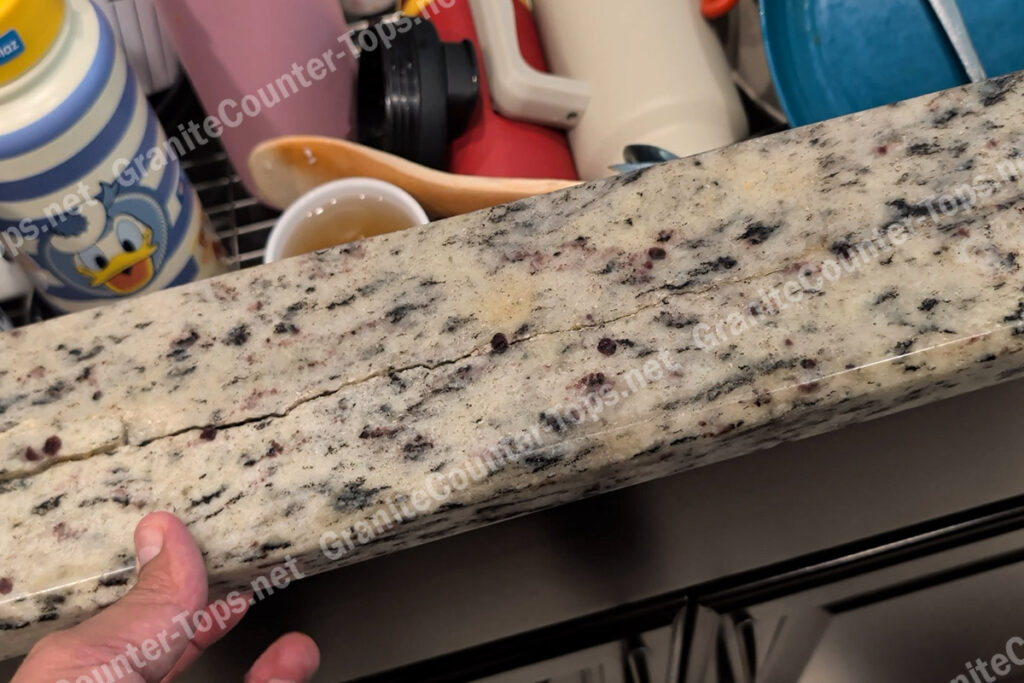
Based on the damage visible in the photos and the information provided, there is a very high likelihood that the cracking is related to a steel reinforcement rod embedded within the granite near the sink cutout.
Over time, moisture can reach the steel reinforcement and cause it to corrode and rust. As the steel corrodes, the rust can expand and create significant internal pressure against the surrounding granite. This pressure may cause the stone to crack, separate, and deteriorate, which is consistent with the type of damage visible in the photos and demonstrated in the accompanying video.
Steel reinforcement rods were commonly used in the fabrication of many older granite countertops, particularly around sink cutouts, where the stone is more vulnerable because a large portion of the countertop has been removed. Although this reinforcement method is less commonly used in modern fabrication, it can still be found in older installations.
It is also important to understand that the reinforcement rod may extend beyond the visibly damaged section. If corrosion is occurring inside the countertop, the affected area may be larger than what is currently visible on the surface.
Based on the visible damage, the suspected cause should be investigated carefully before performing the repair. Removing or addressing the underlying source of the pressure may be necessary to prevent the crack from recurring after the granite is repaired.
2. How to repair cracked granite around a sink?

How to repair cracked granite around a sink
When a granite countertop develops a crack, especially around the sink area, professional granite countertop crack repair is often the best way to restore the stone and prevent further damage. Homeowners in New Jersey and New York can benefit from having the cause of the crack properly identified before attempting a repair.
In some older granite countertops, a rusting steel reinforcement rod inside the stone may be responsible for the damage. When moisture reaches the metal, it can rust and expand, creating pressure that causes the granite to crack or separate.
The best repair option is to address the problem at its source. An experienced granite countertop repair technician can carefully access the damaged area, remove the rusted reinforcement rod when necessary, and thoroughly clean the inside of the stone. The granite is then professionally bonded with a strong adhesive. For a natural-looking finish, the adhesive can be color-matched to the granite.
After the structural repair, the surface can be polished to restore its smooth finish and shine.
However, not every crack requires removal of the reinforcement. Depending on the condition and location of the damage, a professional technician may recommend stabilizing and sealing the crack with a specialized stone adhesive. This method can help prevent moisture penetration and may provide a more affordable repair solution.
Every granite countertop crack repair is different. Serving customers throughout NJ and NY, experienced stone repair professionals can evaluate the damage and recommend the safest, strongest, and most attractive solution. Proper granite repair requires precision, specialized knowledge, and years of hands-on experience.
3. How much does it cost to repair a crack in granite?

How much does it cost to repair a crack in granite?
Professional granite crack repair can involve various methods, and the cost depends on the type of damage, repair complexity, color matching, and the amount of labor required.
1. Granite Crack Filling and Surface Repair
When a granite countertop develops a crack around an area where metal reinforcement or a support rod was installed inside the stone, it may be possible to repair the crack without removing the countertop.
A basic granite crack repair typically starts at around $350, though the final price depends on the damage’s size and complexity.
There is an important difference between simply filling a crack and performing a professional repair that includes color matching. Matching the repair material to the natural color, pattern, and movement of the granite requires experience and skill. For the best results, the repair should be performed by a technician experienced in granite countertop repair and stone restoration.
2. Granite Countertop Removal, Rod Removal, and Structural Repair
If a metal rod has rusted and caused pressure inside the granite, resulting in a serious crack or broken sections, a more extensive repair may be necessary.
This type of granite countertop crack repair may involve carefully removing the stone, extracting the rusted metal reinforcement, repairing and reconnecting the broken sections, and then polishing and restoring the repaired area.
A complex structural granite repair can start at approximately $1,200, depending on the extent of the damage, accessibility, complexity of the repair, and the amount of time required.
Every granite repair is different, and not every technician provides the same level of workmanship. Professional stone repair requires the proper tools, high-quality adhesives, color-matching materials, and experience working with natural stone.
For this reason, it is always best to have an experienced granite repair technician inspect the damage in person before providing a final estimate.
If you only need a simple crack filling with no complicated color matching, the cost may be significantly lower. However, a professional technician generally cannot provide a proper granite repair for only $150 because the job involves travel, materials, equipment, preparation, and skilled labor.
In most cases, the minimum service charge for a professional granite repair technician starts at approximately $350, while larger and more complex repairs can cost considerably more.
The best way to determine the exact cost of granite countertop crack repair is to have the stone inspected by a professional.
4. How to hide a crack in granite?

How to hide a crack in granite
Hiding a crack in a granite countertop requires careful evaluation of the crack’s size, depth, location, and overall condition. Not every granite crack can be repaired in the same way, and the final appearance depends heavily on the repair method and the technician’s experience.
The size of the crack is one of the most important factors. A wider crack may allow professional repair adhesive to penetrate deeper into the stone, creating a stronger bond and a better-looking repair. However, extremely large cracks can indicate more serious structural damage and may require additional reinforcement or restoration.
Very thin, hairline cracks can actually be more challenging to repair because the opening may be too narrow for the adhesive to penetrate properly. In these situations, specialized techniques, tools, and materials may be required to achieve the best possible result.
The location of the granite crack is also important. Cracks near sinks, cooktops, seams, edges, or areas exposed to pressure may require a different repair approach.
Most importantly, the quality of the repair depends on the granite repair technician. An experienced professional uses high-quality stone adhesives, proper color-matching techniques, and proven repair methods to make the crack as discreet as possible.
For the best results, always have a professional inspect the granite countertop before choosing a repair method.
5. Is it common for granite to crack?

Is it common for granite to crack
Granite is one of the strongest and most durable natural stones used for kitchen countertops, and under normal conditions, it is not easy to crack. In many cases, when a granite countertop develops a crack, the cause is not the granite itself but improper installation or metal reinforcement placed inside the stone.
One of the most common causes of granite countertop cracks is a metal support rod installed inside the stone. If the metal begins to rust, it can expand and create pressure within the granite, eventually causing the countertop to crack.
Improper countertop installation can also contribute to cracking. If the granite is not properly supported, leveled, or installed, pressure can develop in certain areas and lead to damage. This can be especially important with granite slabs that contain natural veins, fissures, or other geological characteristics that may make certain areas more sensitive.
Movement or settling of a home can also place stress on a granite countertop. However, when the kitchen cabinets and countertop are installed correctly and properly supported, the risk of cracking is generally much lower.
For this reason, it is important to work with an experienced granite countertop fabricator and installer. Choosing a reputable stone professional can help ensure proper fabrication, installation, support, and inspection.
If your granite countertop develops a crack, have it professionally inspected to determine the actual cause before attempting a repair.
6. What is the average lifespan of granite countertops?

What is the average lifespan of granite countertops?
Granite is one of the most durable natural stones available and can last for decades, generations, and in some cases, potentially thousands of years. When a granite countertop is properly fabricated, supported, and installed, it can provide exceptional durability and long-term performance in your kitchen.
The lifespan of a granite countertop depends greatly on the quality of the stone, fabrication, installation, and support underneath the countertop. Proper cabinet installation is especially important because uneven or inadequate support can place unnecessary stress on the granite.
Another important factor is how the stone is fabricated. In some installations, metal reinforcement rods may be installed into the granite. When this is done incorrectly, or the reinforcement begins to corrode, it can create internal pressure in the stone and contribute to cracking.
Some granite varieties are known for their exceptional hardness and durability, including Absolute Black, Black Galaxy, and other dense, heavy granite varieties**. However, weight alone does not determine whether one granite is stronger than another.
With proper fabrication, professional installation, adequate cabinet support, and routine care, a high-quality granite countertop can remain beautiful and functional for many years. Choosing an experienced granite countertop fabricator and installer is one of the best ways to protect your investment and reduce the risk of future cracks or damage.
7. What happens if you don’t seal granite every year?

What happens if you don’t seal granite every year
Granite is a durable and beautiful natural stone, but proper maintenance is important to protect its appearance. If a granite countertop is not properly sealed, certain liquids and staining materials may penetrate the stone and leave permanent marks. The level of protection also depends on the specific type and porosity of the granite.
For many granite countertops, applying a high-quality stone sealer periodically can help reduce absorption and protect the surface from everyday stains. A professional can determine when your granite needs resealing based on the stone’s type and condition.
However, it is important to understand that a granite sealer does not protect against all types of damage. Strong acids or other chemical substances can etch, discolor, or otherwise damage natural stone, even when the countertop has been sealed.
For example, one homeowner had a Blue Pearl Granite countertop that was damaged after oranges and their acidic juice were left on the surface for an extended period. As the oranges deteriorated, the acidic juice remained in contact with the granite and eventually caused visible damage, including small pits or damaged areas in the stone. Blue Pearl Granite is known for being a strong, durable granite, yet it demonstrates that even durable natural stone can be affected by prolonged exposure to acidic substances.
A quality granite sealer can help protect against stains, but it cannot prevent chemical etching or acid damage. For the best results, clean spills promptly and consult a professional granite countertop specialist about the correct sealer and maintenance routine for your specific stone.
8. Can a chipped granite edge be repaired?

Can a chipped granite edge be repaired?
Granite is well known as one of the strongest and most durable natural stones for kitchen countertops. However, even granite can develop a chip under the right circumstances. The likelihood depends on the specific type of granite, the fabrication, and the location of the countertop.
Granite can chip when a hard or heavy object hits a sharp countertop edge or corner with enough force. Areas around sinks, cooktops, overhangs, and exposed edges can be more vulnerable because they are subject to greater impact.
Compared with many quartz countertops, certain granite varieties can be highly resistant to chipping. However, no countertop material is completely chip-proof. The stone’s natural characteristics, including its mineral structure and existing fissures, can also affect its durability.
The good news is that granite chip repair is often very successful. An experienced stone repair technician can fill the damaged area, carefully match the color and texture, and finish the repair so it blends with the surrounding granite.
In many cases, a professionally repaired granite chip can be very difficult to notice, especially when high-quality materials and proper color-matching techniques are used.
If your granite countertop has a chip, professional granite chip repair is often a better option than replacing the entire countertop.
9. Granite Countertop Repair in New Jersey, New York & Philadelphia
If you are looking for professional granite countertop repair in New Jersey, New York, or Philadelphia, our experienced stone repair specialists can help restore damaged granite countertops without the need for complete replacement. Granite is extremely durable, but it can still develop chips, cracks, broken corners, scratches, seam damage, and other surface problems from everyday use, impact, or improper support.
We provide professional granite repair services throughout New Jersey, New York, and Philadelphia, helping homeowners, businesses, contractors, and property managers restore their existing stone countertops. Our repair services are designed to improve both the appearance and functionality of damaged granite while preserving as much of the original countertop as possible.
Our granite countertop repair services include granite crack repair, granite chip repair, broken edge and corner repair, seam repair, surface restoration, polishing, and color matching. Each repair is carefully evaluated to determine the most appropriate repair method for the type and location of the damage.
Whether your granite countertop has a small chip near the edge, a crack around the sink, a damaged corner, or a separated seam, professional repair may be a practical alternative to replacing the entire countertop. Proper repair can help prevent additional damage and restore a clean, finished appearance.
We proudly serve customers searching for granite countertop repair in NJ, granite countertop repair in New York, and granite countertop repair in Philadelphia. If your granite countertop is damaged, contact us to discuss your repair project and find out whether your existing stone can be professionally restored.